Ramps
A forcing switched on at full strength in a model at rest excites waves that take days to leave the domain. Cocoa scales each forcing by a ramp that rises from 0 to 1 instead. Every ramp in the configuration is the same block:
forcing:
  ramp:
    enabled: true      # default true
    duration: 1d       # time to rise from 0 to 1
    form: tanh         # the curve it rises along
    delay: 0           # time held at 0 before it rises
Where Ramps Apply
The spin-up ramps start once, near the start of the run:
Block |
Scales |
|---|---|
|
Tidal potential and boundary forcing, and meteorology unless
|
|
Wind and pressure forcing; a key it omits takes the value from
|
|
Flow boundary discharge and elevation (Boundary Conditions) |
|
The baroclinic pressure gradient, internal-tide drag and dispersion (Baroclinic Coupling) |
|
The water level correction (Data Assimilation) |
Each starts at the cold start (simulation.start_time), except the
meteorological ramp, which starts at the earlier of the cold start and the
first meteorological snapshot. Each defaults to enabled, one day and
tanh. A restart continues every ramp from its original start rather
than starting it again.
The activation fades bring a meteorological source in and out partway
through the run: domains[i].ramp for one domains: entry and
vortex.ramp for each storm track (Activation Ramp). A fade
starts at its source’s own window edges, so it takes the block without
delay. Fades are off by default, and an enabled fade must give its
duration.
Keys
Key |
Type |
Default |
Description |
|---|---|---|---|
|
bool |
true |
A disabled ramp is 1 throughout. |
|
duration |
|
Time the ramp takes to rise from 0 to 1. 0 means no ramp, or a step
when |
|
string |
|
|
|
duration |
|
Time after the ramp’s start during which it is 0, so the forcing is
off. It then rises over |
Forms
With \(x\) the fraction of duration elapsed since the delay ended,
clamped to \([0, 1]\), the forms are:
|
Ramp value |
Slope, for a duration \(T\) |
|---|---|---|
|
\(\tanh(2x)/\tanh(2)\) |
Jumps from 0 to \(2.07/T\) at the start and ends at \(0.15/T\) |
|
\(x\) |
Jumps from 0 to \(1/T\) at the start and back to 0 at the end |
|
\(3x^2 - 2x^3\) |
Zero at both ends, peaking at \(1.5/T\) mid-ramp |
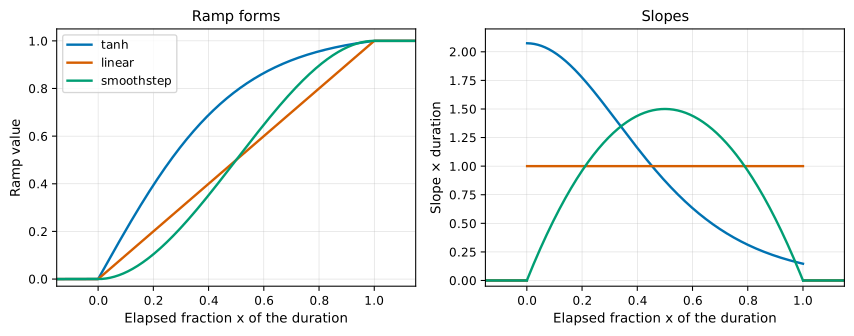
Fig. 4 The three forms (left) and their slopes in units of \(1/T\) (right).
tanh brings the forcing in fastest; smoothstep is the only form
whose slope does not jump where the ramp starts and ends.
A ramp evaluated every time step with smoothstep adds no jump to the
forcing’s rate of change, though the forcing’s own interpolation between data
times may still have one.
Activation Fades
A fade with duration \(T\) on a source whose window runs from \(t_{open}\) to \(t_{close}\) weights the source by
where \(r\) is the block’s form. A window shorter than \(2T\)
never reaches full weight: for a window of length \(L\) the weight is
at most \(r(L/2T)^2\), reached mid-window. For a window half the fade
duration, that is 0.23 with tanh, 0.06 with linear and 0.02 with
smoothstep, so a short-lived source needs a short fade.
A vortex or a moving storm grid evaluates its weight every time step. A gridded domain evaluates it at the meteorological snapshot times (every gridded source’s times, merged) and interpolates it linearly between them, so its form shapes the fade only when the fade spans several data intervals: with only 6-hourly data, a 6-hour fade is the same straight line whatever its form. Activation Ramp describes how the weight blends a source into the composed field.
With debug logging, the startup log describes each enabled spin-up ramp as
<form> ramp over <hours> h from <time> or step at <time>.