Global Simulations
This guide covers the setup and configuration of global ocean simulations in Cocoa. Global models present unique challenges compared to regional coastal models, including coordinate singularities at the poles and handling elements that cross the prime meridian or date line.
Overview
Global ocean models cover the entire Earth’s ocean surface. Unlike regional models that can ignore edge effects, global models must handle:
Pole singularities: The shallow water equations have singularities at geographic poles where meridians converge and the Coriolis parameter approaches its maximum value.
Meridian discontinuities: Elements that span the \(\pm 180\)° longitude line have coordinate discontinuities that can cause incorrect geometry calculations.
Spherical geometry: Scale factors and metric corrections become more important when the domain spans large latitude ranges.
Cocoa addresses these challenges through:
Automatic meridian crossing detection: Elements straddling the antimeridian are automatically detected and corrected during mesh initialization.
Coordinate rotation: An optional coordinate transformation that relocates the computational poles away from the geographic poles.
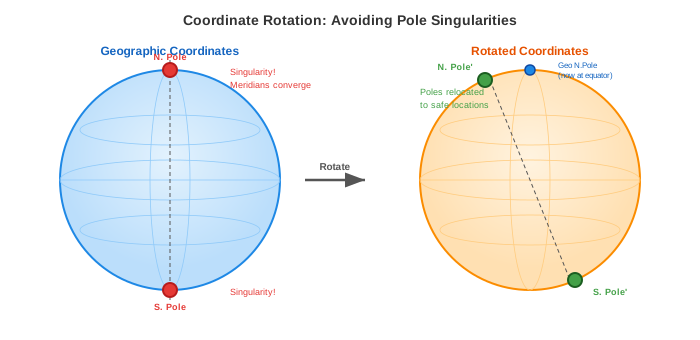
Fig. 4 Coordinate rotation relocates the computational poles (singularities) from the geographic poles to other positions, usually which are well over land, effectively removing the singularities from the model.
When to Use Coordinate Rotation
Coordinate rotation is required when your global mesh includes elements near the geographic poles (typically within 5-10 degrees of \(\pm 90\)° latitude). Without rotation, simulations will experience:
Numerical instability from near-singular Coriolis terms
Time step restrictions due to converging meridians
Degraded solution quality in polar regions
Coordinate rotation is not required for:
Regional models (any latitude range)
Global models that exclude polar regions (e.g., \(\pm 80\)° latitude bounds)
Note
If your mesh was generated with ADCIRC’s rotated pole system (IFSPROTS=1), you should use the same rotation parameters in Cocoa for consistency.
Configuration
Basic Global Mesh Setup
A minimal configuration for a global simulation without rotation:
mesh:
  filename: "global_mesh.nc"
  projection:
    type: "Mercator"
    center: [0.0, 0.0]  # Centered on equator

simulation:
  start_time: 2025-01-01
  end_time: 2025-02-01
  time_step: 60s  # Global models often need larger time steps

physics:
  manning_n: 0.025
  tau0: 0.005
The projection center [0.0, 0.0] places the reference point at the
intersection of the prime meridian and equator, which is typical for global
models.
Global Mesh with Coordinate Rotation
For global models including polar regions, enable coordinate rotation:
mesh:
  filename: "global_mesh_with_poles.nc"
  projection:
    type: "Mercator"
    center: [0.0, 0.0]
  rotation:
    enabled: true
    pole_location: [0.0, 0.0]  # New pole at (lon=0, lat=0)
The pole_location specifies where the geographic North Pole will be
relocated to in the rotated coordinate system. This uses the same format as
ADCIRC’s znorth_in_spherical_coors in the fort.rotm file.
Common choices:
Pole Location |
Effect |
|---|---|
|
North Pole moves to equator at prime meridian |
|
North Pole moves to equator at date line |
|
North Pole moves to equator in Atlantic |
The best choice depends on your domain and the location of your areas of interest. Ideally, the rotated poles should be placed in regions of less importance to your simulation (e.g., over land or in deep ocean far from your study area).
Choosing a Pole Location
When selecting the pole location, consider:
Avoid areas of interest: The new poles will have numerical singularities, so place them where solution accuracy is less critical.
Land placement: Placing poles over land (e.g., Antarctica or northern Canada) is ideal if your mesh excludes those regions.
Match existing meshes: If your mesh was generated with ADCIRC using rotated coordinates, use the same pole location for consistency.
Understanding Rotation Effects
When coordinate rotation is enabled, several quantities are affected:
Coordinates
All node coordinates are transformed from geographic \((\lambda, \phi)\) to rotated \((\lambda', \phi')\) coordinates. The mesh file remains unchanged; transformations happen at runtime.
Coriolis Parameter
The Coriolis parameter \(f = 2\Omega\sin\phi\) uses the rotated latitude \(\phi'\), not the geographic latitude. This is correct because the Coriolis effect depends on the local vertical component of Earth’s rotation vector, which is properly captured in the rotated frame.
Tidal Potential
Tidal potential forcing (gravitational attraction from the Moon and Sun) uses geographic latitude \(\phi\). This is a physical requirement because the tidal potential depends on the actual position relative to celestial bodies.
Velocities
Velocities are computed in the rotated coordinate frame (rotated east/north directions). For output, Cocoa transforms velocities back to the geographic frame so that output files show true eastward (u) and northward (v) components.
Projection Selection
For global simulations, projection choice affects numerical accuracy:
Projection |
Recommendation |
|---|---|
Mercator |
Best for global models with rotation. Conformal (angle-preserving) properties are important for accurate velocity calculations. Requires rotation if including high latitudes. |
Equidistant Cylindrical |
Acceptable for global models. Simple but introduces errors at high latitudes. |
Equal Area |
Good for mass conservation, but distorts shapes. Use when accurate integrated quantities are more important than local accuracy. |
Miller |
A compromise between Mercator and cylindrical equal-area. Moderate distortion at all latitudes. |
Gall Stereographic |
Cylindrical projection with two standard parallels at 45 degrees. Moderate distortion compromise. |
Complete Example
A complete configuration for a global ocean model with tidal potential forcing, self-attraction and loading (SAL), and spatially varying friction. This corresponds to the Global Ocean test case:
output:
  step_interval: 5

diagnostics:
  screen_interval: 60
  log_file: log.json

mesh:
  filename: "global.nc"
  projection:
    type: "Mercator"
    center: [0.0, 45.0]
  rotation:
    enabled: true
    pole_location: [114.16991, 0.77432]

simulation:
  start_time: 2025-01-01
  end_time: 2025-02-01
  time_step: 12m

physics:
  manning_n: "mesh"
  cf_lower_limit: 0.0010
  tau0: 0.0022222
  smagorinsky_coefficient: 0.2
  min_viscosity: 1.0e-6

numeric:
  solver: implicit
  gwce_coefficients: [0.5, 0.5, 0.0]

forcing:
  ramp:
    enabled: true
    duration: 5d
  tide:
    sal:
      enabled: true
    potential:
      enabled: true

initial_conditions:
  water_level: 0.0
Key aspects of this configuration:
Coordinate rotation relocates the North Pole to
[114.16991, 0.77432], placing the singularity over land (Borneo).Mercator projection centered at 45°N provides conformal mapping.
Spatially varying friction (
manning_n: "mesh") reads Manning’s n values from a mesh variable rather than using a uniform value.SAL correction (
tide.sal.enabled: true) accounts for self-attraction and loading effects on the tide.Tide potential is enabled without specifying constituents — Cocoa automatically computes tidal potential forcing from built-in constituent parameters.
Implicit solver with
gwce_coefficients: [0.5, 0.5, 0.0]enables the large 720-second time step needed for efficiency on a global domain.No tidal boundary section is needed because a global mesh has no open boundaries.
See Also
Coordinate Rotation - Mathematical details of the rotation system
Prime Meridian Crossing - How meridian crossings are detected
Mesh Preparation - Creating mesh files for Cocoa