Astronomical Tides
Cocoa implements direct astronomical tide potential computation using algorithms from Jean Meeus’s Astronomical Algorithms (2nd ed., 1998). This approach computes tide-generating forces directly from calculated Moon and Sun positions, providing accurate tidal forcing without requiring pre-computed harmonic constituents or external ephemeris tables.
Physical Basis
The gravitational tide-generating potential arises from the differential attraction of the Moon and Sun across the Earth. At a point on Earth’s surface, the potential due to a celestial body is:
where:
\(G\) is the gravitational constant
\(M\) is the mass of the celestial body (Moon or Sun)
\(\Delta\) is the distance from Earth’s center to the body
\(R_e\) is Earth’s radius
\(P_n\) are Legendre polynomials
\(\zeta\) is the zenith angle (angle between the observer and the body)
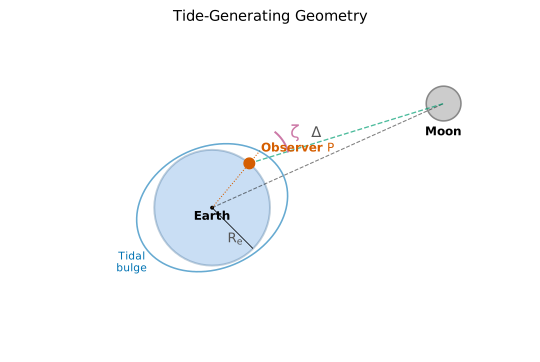
Fig. 25 Tide-generating geometry. The zenith angle \(\zeta\) is measured between the observer’s local vertical and the direction to the Moon (or Sun). The tidal bulge is exaggerated for clarity.
The \(n=1\) term vanishes because it represents uniform translation of the Earth-Moon or Earth-Sun system.
Degree-2 Equilibrium Tide
The dominant contribution comes from the degree-2 (\(n=2\)) term, which produces the familiar equilibrium tide pattern. The second-degree Legendre polynomial is:
This creates a prolate spheroidal water surface with two bulges pointing toward and away from the attracting body.
Higher-Order Terms
Cocoa supports higher-order expansions for improved accuracy:
P2 (order=2): Standard equilibrium tide, fastest computation
P3 (order=3): Adds the degree-3 term for improved coastal accuracy
Exact (order>=4): No higher-degree terms are implemented; this setting routes to the same degree-2 + degree-3 (P3) kernel
The degree-3 term uses:
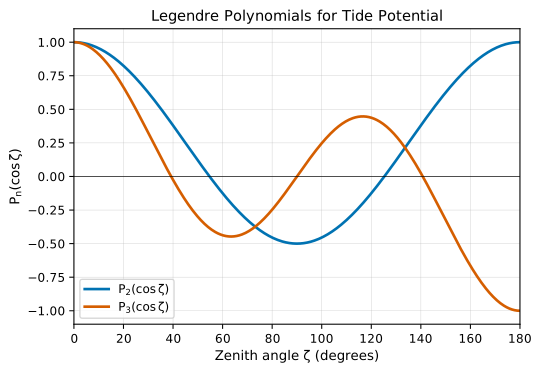
Fig. 26 Legendre polynomials \(P_2(\cos\zeta)\) and \(P_3(\cos\zeta)\) used in the tide-generating potential expansion.
Jean Meeus Algorithms
Cocoa uses algorithms from Meeus’s Astronomical Algorithms to compute celestial body positions analytically with sub-arcminute accuracy. These polynomial and periodic series expressions eliminate the need for external ephemeris tables.
Julian Day and Time
All calculations use Julian Day Number (JD), with time measured in Julian centuries (\(T\)) from the J2000.0 epoch (January 1, 2000, 12:00 TT):
Moon Position (Chapter 47)
The Moon’s geocentric position is computed using a 60-term periodic series from Meeus Chapter 47. The algorithm computes:
Mean elements: Mean longitude, mean anomaly, mean elongation, and argument of latitude using polynomial expressions in \(T\)
Periodic corrections: Additive corrections using sine series for longitude and latitude, cosine series for distance
Ecliptic coordinates: Geocentric ecliptic longitude (\(\lambda\)), latitude (\(\beta\)), and distance (\(\Delta\))
The series achieves accuracy of approximately 10 arcseconds in position and 0.2 kilometers in distance over several centuries.
Key orbital elements computed:
Element |
Symbol |
Description |
|---|---|---|
Mean longitude |
\(L'\) |
Moon’s mean angular position |
Mean anomaly |
\(M'\) |
Position in elliptical orbit |
Mean elongation |
\(D\) |
Angular distance from Sun |
Argument of latitude |
\(F\) |
Position relative to ascending node |
Sun Position (Chapter 25)
The Sun’s apparent geocentric position uses the simplified algorithm from Meeus Chapter 25:
Compute the geometric mean longitude and mean anomaly of the Sun
Apply the equation of center (correction for elliptical orbit)
Calculate apparent longitude including aberration and nutation
The Sun’s distance is computed as:
where \(e\) is Earth’s orbital eccentricity and \(\nu\) is the true anomaly.
Sidereal Time (Chapter 12)
Greenwich Mean Sidereal Time (GMST) relates Earth’s rotation to the celestial reference frame:
Greenwich Apparent Sidereal Time (GAST) includes the nutation correction:
where \(\Delta\psi\) is the nutation in longitude and \(\epsilon\) is the obliquity of the ecliptic.
Nutation and Obliquity (Chapter 22)
Nutation is the periodic oscillation of Earth’s rotation axis caused primarily by the Moon’s orbital precession. Cocoa computes:
Nutation in longitude (\(\Delta\psi\)): affects right ascension
Nutation in obliquity (\(\Delta\epsilon\)): affects declination
The mean obliquity of the ecliptic is:
True obliquity includes the nutation correction: \(\epsilon = \epsilon_0 + \Delta\epsilon\)
Coordinate Transformations
Ecliptic to Equatorial
Celestial positions are computed in ecliptic coordinates and transformed to equatorial coordinates (right ascension \(\alpha\), declination \(\delta\)):
Hour Angle and Zenith Angle
The local hour angle relates sidereal time to right ascension:
where \(\phi_{lon}\) is the observer’s longitude.
The zenith angle is computed from:
where \(\phi_{lat}\) is the observer’s latitude.
Earth Elasticity
The solid Earth deforms in response to tidal forces. This is accounted for using Love numbers:
\(k_2 = 0.302\): Body tide (elastic deformation of Earth)
\(h_2 = 0.609\): Vertical displacement of Earth’s surface
The ocean tide amplitude is reduced by the Earth elasticity factor:
This factor accounts for the gravitational effect of the body tide (\(k_2\)) partially offsetting the ocean tide, while the surface displacement (\(h_2\)) further reduces the effective water column change.
Implementation Details
Cocoa’s astronomical tide implementation uses a split HOST/DEVICE computation model optimized for GPU execution:
HOST (once per timestep):
Compute Julian Day from simulation DateTime
Calculate Moon position using Meeus Chapter 47 series
Calculate Sun position using Meeus Chapter 25
Compute GMST from Meeus Chapter 12
Transform to equatorial coordinates
DEVICE (parallel over mesh nodes):
Compute local hour angles for Moon and Sun
Calculate zenith angles at each node
Evaluate Legendre polynomial expansion
Apply Earth elasticity factor and ramp
The latitude-dependent trigonometric factors (\(\cos\phi\), \(\sin\phi\)) are precomputed and stored on the device to avoid redundant calculations.
References
Meeus, J. (1998). Astronomical Algorithms, 2nd Edition. Willmann-Bell.
Doodson, A.T. (1921). The harmonic development of the tide-generating potential. Proceedings of the Royal Society A, 100(704), 305-329.
Cartwright, D.E. & Tayler, R.J. (1971). New computations of the tide-generating potential. Geophysical Journal International, 23(1), 45-74.
Wahr, J.M. (1981). Body tides on an elliptical, rotating, elastic and oceanless Earth. Geophysical Journal International, 64(3), 677-703.