Performance
Cocoa is designed for high performance on modern GPU and CPU architectures. This page presents benchmark results comparing Cocoa with ADCIRC on a representative large-scale simulation, including strong-scaling behavior in CPU-MPI mode and single-GPU performance across three GPU generations.
Benchmark Configuration
The benchmark is a Hurricane Katrina (2005) hindcast with the following characteristics:
Mesh size: 1,568,749 nodes
Forcing: Tidal boundary, tidal potential, and hurricane wind and pressure fields
Time step: 2 s for both the implicit and explicit (lumped-mass) solvers, for both models
Simulated duration: 25 days
ADCIRC runs use double precision throughout. Cocoa computes in double precision with single-precision storage for bandwidth-bound fields.
Hardware:
CPU (PSC Bridges-2): dual-socket AMD EPYC 7742 64-core nodes (128 cores per node), 128 to 1024 MPI ranks (1 to 8 nodes)
GPU (Lambda Labs): NVIDIA H100 (SXM5, host Intel Platinum 8480+) and NVIDIA B200 (SXM6, host Intel Platinum 8592+), single device
GPU (workstation): NVIDIA V100 (host AMD Ryzen 9 9950X), single device
Both solvers use the same time step (2 s) and run for the same simulated duration, so the implicit and explicit results are a direct, step-for-step comparison. Results are still presented separately per solver because they exercise different work per step.
Implicit Solver Results
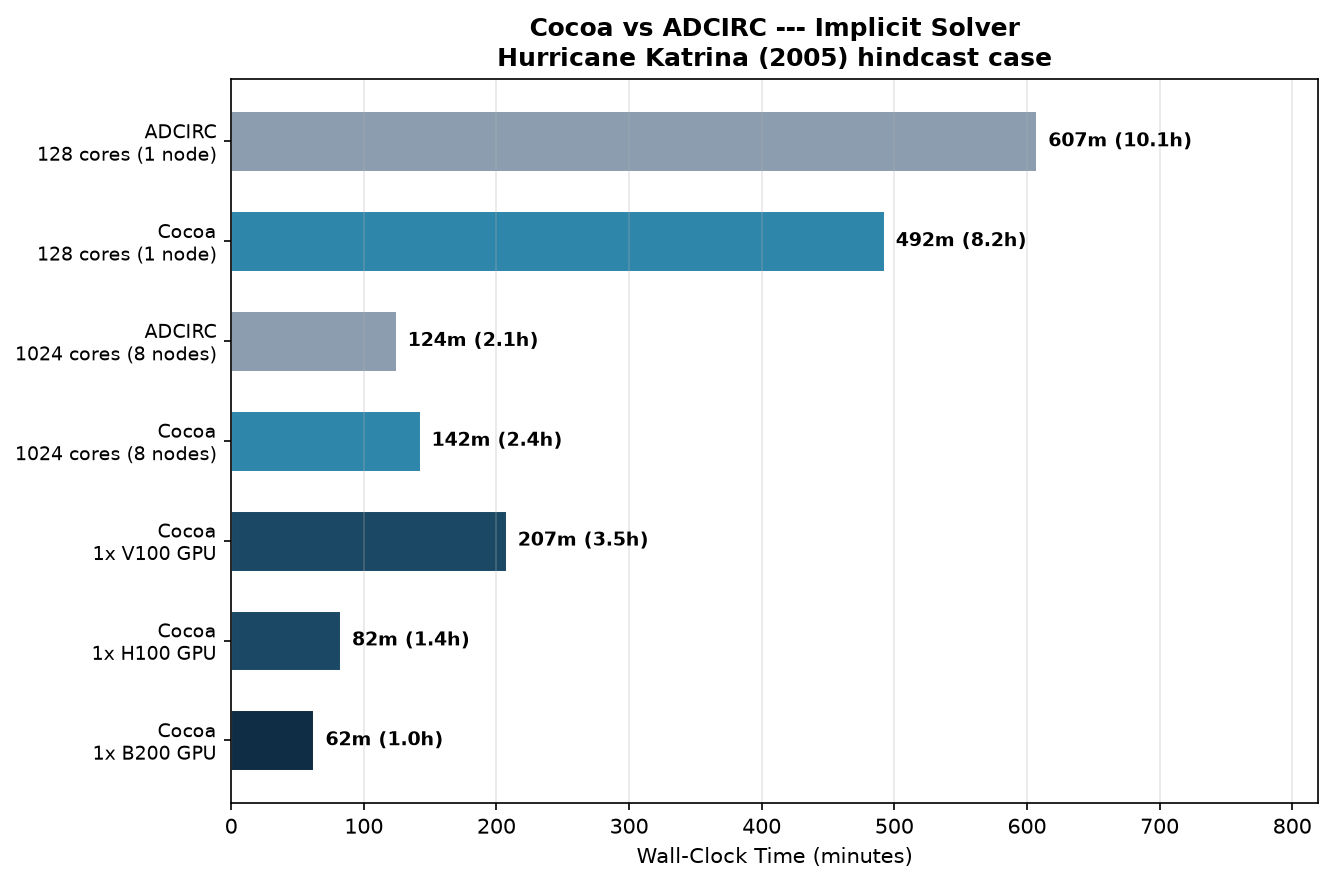
Fig. 12 Wall-clock time for the implicit solver (dt=2s) on the 1.57M-node Hurricane Katrina hindcast.
Model |
Hardware |
Wall Time |
|---|---|---|
ADCIRC |
128 cores (1 node) |
607m (10.1h) |
Cocoa |
128 cores (1 node) |
492m (8.2h) |
ADCIRC |
1024 cores (8 nodes) |
124m (2.1h) |
Cocoa |
1024 cores (8 nodes) |
142m (2.4h) |
Cocoa |
1x V100 GPU |
207m (3.5h) |
Cocoa |
1x H100 GPU |
82m (1.4h) |
Cocoa |
1x B200 GPU |
62m (1.0h) |
Explicit Solver Results
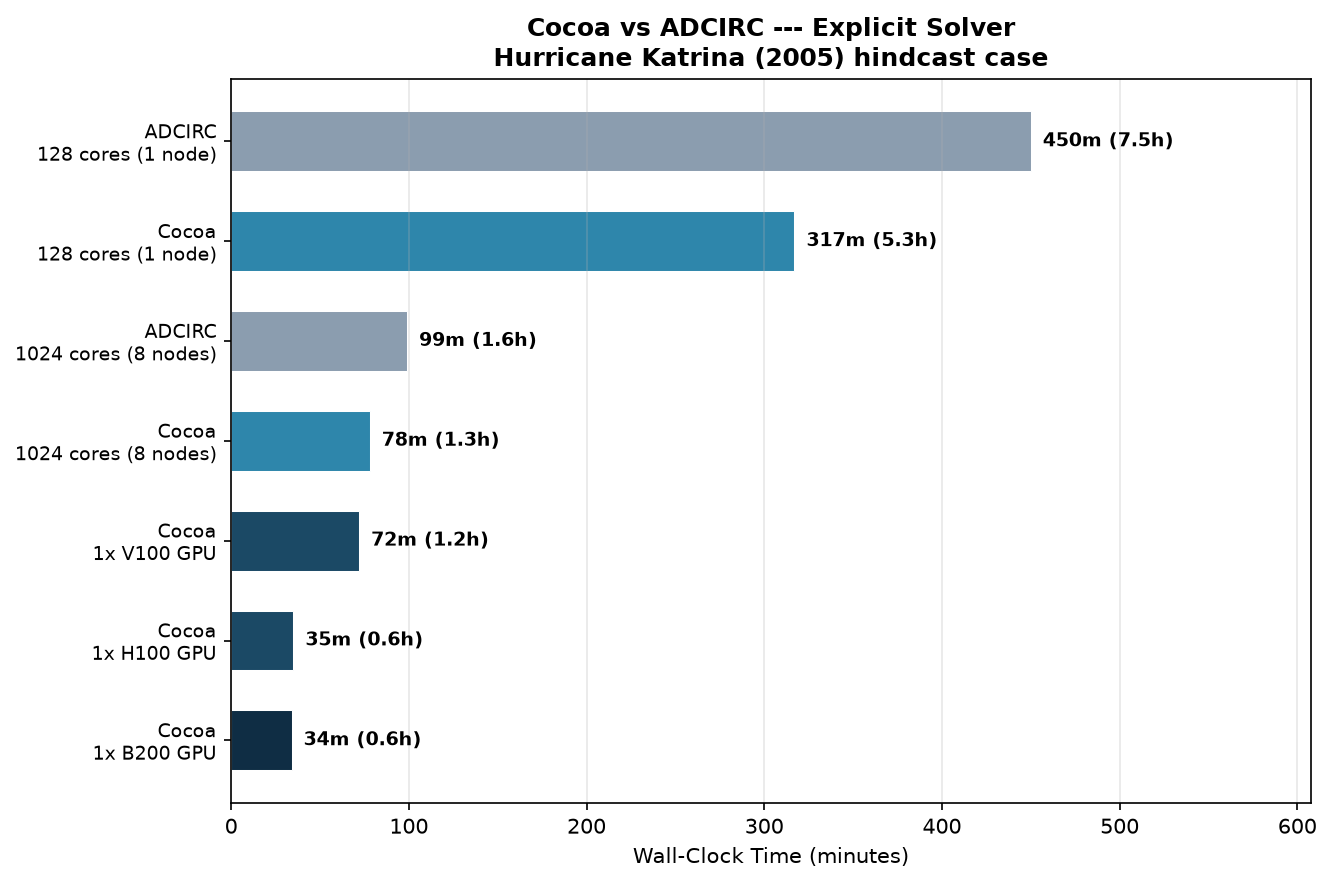
Fig. 13 Wall-clock time for the explicit lumped-mass solver (dt=2s) on the 1.57M-node Hurricane Katrina hindcast.
Model |
Hardware |
Wall Time |
|---|---|---|
ADCIRC |
128 cores (1 node) |
450m (7.5h) |
Cocoa |
128 cores (1 node) |
317m (5.3h) |
ADCIRC |
1024 cores (8 nodes) |
99m (1.6h) |
Cocoa |
1024 cores (8 nodes) |
78m (1.3h) |
Cocoa |
1x V100 GPU |
72m (1.2h) |
Cocoa |
1x H100 GPU |
35m (0.6h) |
Cocoa |
1x B200 GPU |
34m (0.6h) |
CPU-MPI Scaling
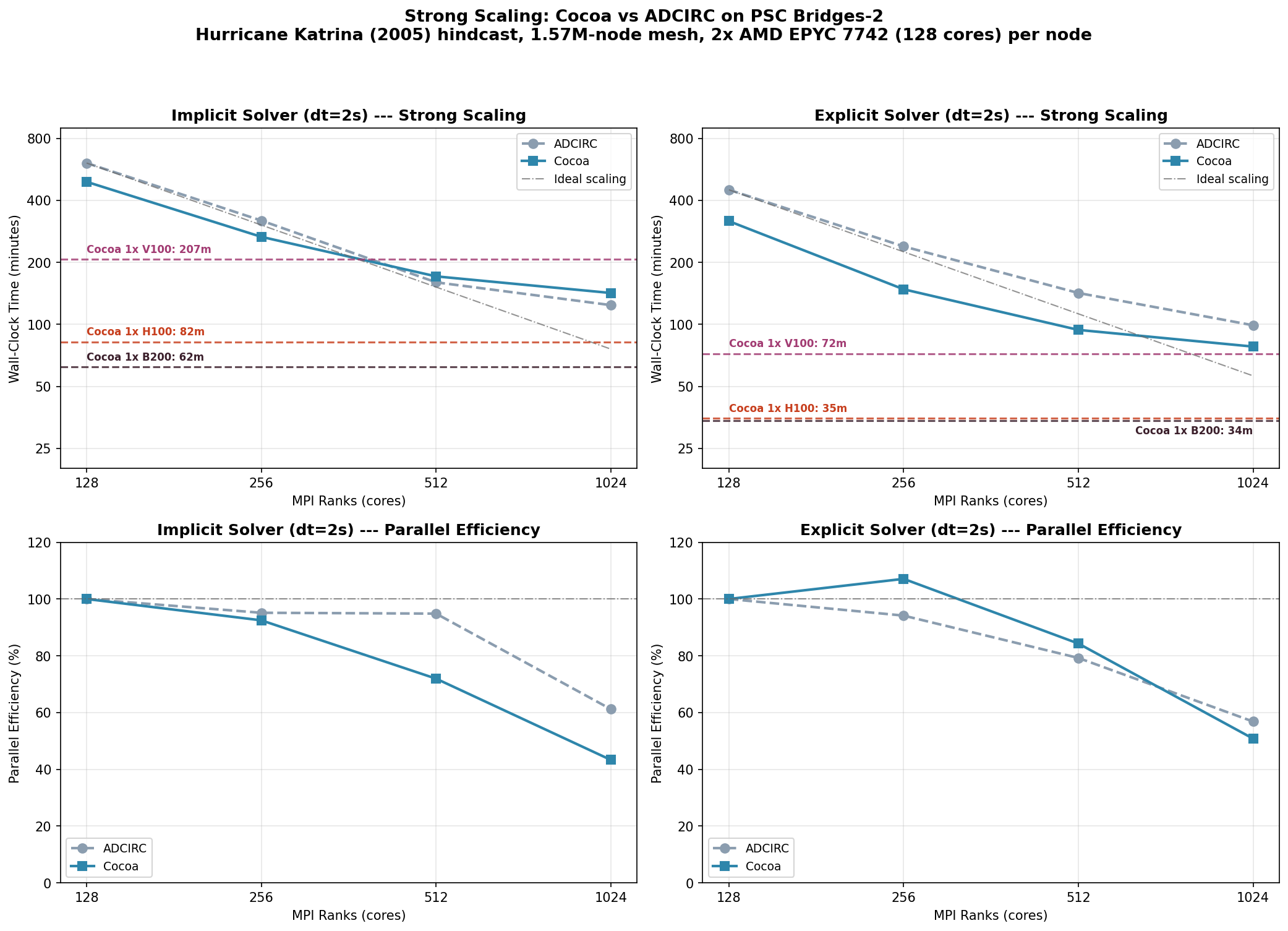
Fig. 14 Top: log-log scaling of wall-clock time vs MPI ranks on PSC Bridges-2, one panel per solver, with horizontal reference lines marking Cocoa’s single-GPU wall times for the same solver. Bottom: parallel efficiency relative to each configuration’s own 128-core run.
Wall-clock time in minutes by MPI rank count:
Ranks |
Cocoa Implicit |
ADCIRC Implicit |
Cocoa Explicit |
ADCIRC Explicit |
|---|---|---|---|---|
128 |
492 |
607 |
317 |
450 |
256 |
266 |
319 |
148 |
239 |
512 |
171 |
160 |
94 |
142 |
1024 |
142 |
124 |
78 |
99 |
Quadrilateral and Hybrid Meshes: Zero Cost on Triangle-Only Runs
A mesh with zero quadrilaterals runs through the same device kernels, launch
counts, and allocations as it did before quadrilateral support existed.
Every quadrilateral code path is guarded by if (num_quads > 0) at the
launch site, never inside a shared kernel body: the quadrilateral tables
(ElementTables<Quadrilateral>) default-construct to zero-extent Views, no
quadrilateral compactor is constructed, and no quadrilateral kernel is
launched. This was checked by comparing the Kokkos kernel-timer launch list
and the Kokkos::View allocation labels on a triangle-only production mesh
(WNAT) before and after each change: identical names, identical counts.
Machine code and timing. An identical launch list does not prove the
triangle kernels themselves are unaffected, since a shared header touched to
add the element-type tag could still change triangle code generation, so
every change to shared code was checked two ways: the SASS of every kernel
was compared byte for byte against main, and two binaries were run
through the same production configuration under nsys profile with
interleaved, order-alternated repeats and every kernel’s median per-step
time compared at a 1% gate. On the gstofs production mesh (12.8M nodes)
every triangle kernel compiles to SASS byte-identical to main except the
GWCE right-hand-side and momentum assembly kernels, which carry the
per-element advection predicate; the per-step time is 0.2% below main
in both run orders and the two changed kernels sit within slot-order drift.