Baroclinic Coupling
Cocoa can couple a depth-averaged (2DDI) hydrodynamic solve to an external 3D ocean climatology through three terms: a horizontal baroclinic pressure gradient (BPG) with its free-surface correction, an internal-tide wave-drag friction enhancement, and a dispersion friction correction. All three read a single preprocessor-generated nodal forcing file (Configuration) and share a common activation ramp.
The method follows the 2DDI approach of Pringle et al. (2019)
[Pringle2019] and its global application [Pringle2021], as refined in
ADCIRC by C. Blakely, whose global tidal dissipation analysis
[Blakely2022] underpins the internal-tide drag’s role in the global
model. The internal-tide and dispersion terms are carried over from
ADCIRC’s nodalattr.F and internaltide.F90.
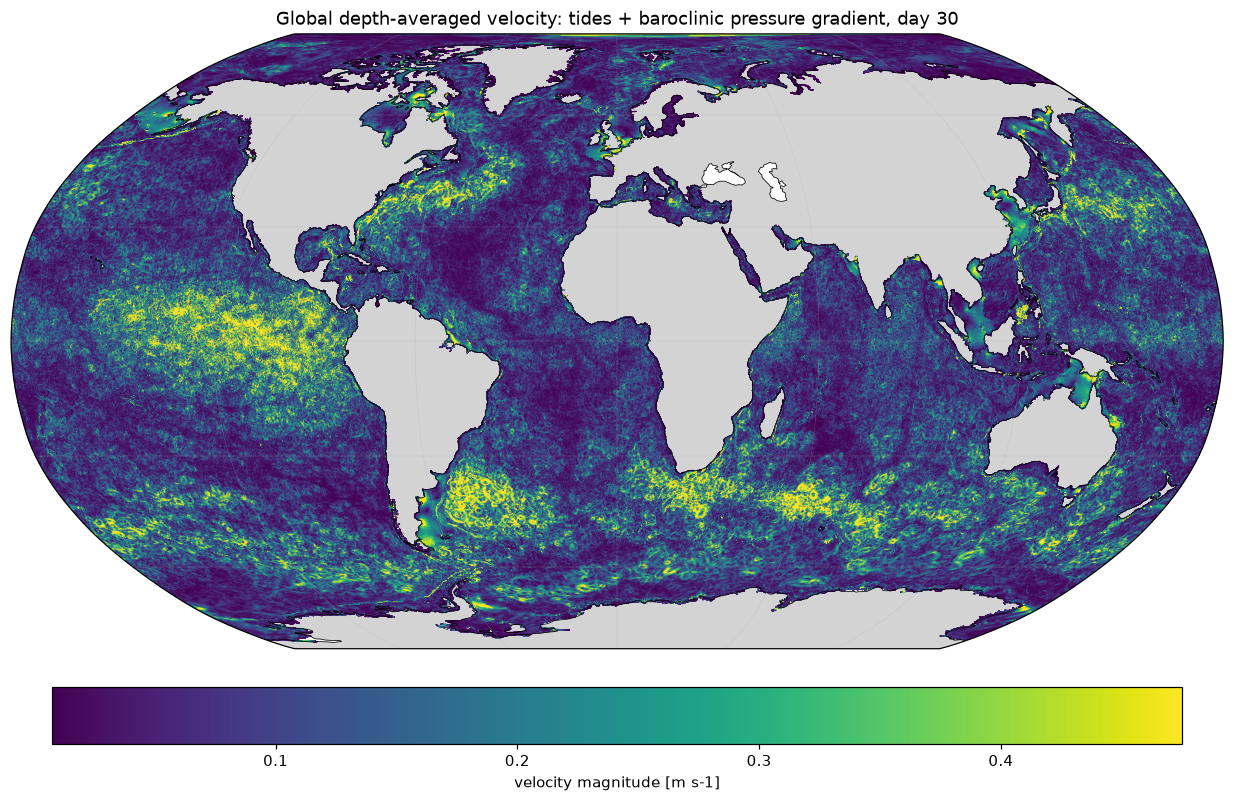
Fig. 6 Depth-averaged velocity magnitude on a 3.7M-node global shell, forced by tides plus a single frozen (diagnostic-mode) RTOFS density snapshot, at day 30 of spin-up. The western boundary currents and the Antarctic Circumpolar Current are resolved.
Overview
A depth-averaged model has no vertical structure, so it cannot represent
the pressure gradient a real 3D density field produces, the drag a
stratified ocean exerts on the barotropic tide through internal-wave
generation, or the extra bottom friction implied by unresolved vertical
shear. Cocoa closes these gaps with fields computed offline from a 3D
ocean climatology (HYCOM GOFS 3.1) by the cocoa_ocean3d Python
preprocessor and interpolated onto mesh nodes as a CF NetCDF time series:
The BPG and its free-surface correction (Baroclinic pressure gradient) enter GWCE and momentum as an extra pressure-gradient forcing, in the same way as the barotropic term.
Internal-tide wave drag (Internal-tide wave drag) adds a symmetric 2x2 friction-tensor contribution, active only where internal tides can propagate freely.
Dispersion as friction (Dispersion as friction) adds a further friction-tensor contribution representing depth-averaging error.
All three are gated independently under forcing.baroclinic (see
Configuration) and share the file’s BPG, sigma-t, buoyancy-frequency,
and mixed-layer products; enabling internal-tide drag or dispersion
without the parent enabled: true is rejected at startup.
Theory
Baroclinic pressure gradient
The 2DDI BPG at a mesh node is a depth-averaged, horizontal derivative of the baroclinic pressure anomaly
computed by the preprocessor from a TEOS-10 (GSW) in-situ density profile
via one-sided horizontal differences and a trapezoidal vertical integral
(cocoa_ocean3d.bpg). \(\mathrm{BPG}_y\) is defined identically in
the meridional direction. Both are staggered, with BPGX at longitude
midpoints and BPGY at latitude midpoints, and the vertical integral is
truncated at the shallower of any two neighboring wet columns, never
extrapolated past the shallower column’s seabed. The preprocessor clamps
the horizontal density-anomaly bracket to \(\pm 0.1\) kg/m
3 before scaling by \(g/\rho_0\), bounding
\(|\mathrm{BPG}| \le g/\rho_0 \times 0.1 \approx 9.8\times10^{-4}\)
m/s 2.
The BPG enters GWCE and momentum with the same sign convention as the
barotropic pressure gradient
(Physics::BaroclinicGradient::compute_momentum_contribution /
compute_gwce_contribution): the momentum contribution is area-weighted
and Crank-Nicolson time-centered, each node of element \(e\) receiving
its own nodal value,
so that dividing by the node’s wet area recovers \(\mathrm{BPG}_i\)
exactly, as ADCIRC’s per-node DBCPDX1A/2A/3A do (a quadrilateral weights
each corner by its lumped area weight in place of \(A_e\)). The GWCE
contribution is the negative element average of the nodal products,
\(-\overline{H_i\,\mathrm{BPG}_i}\). Time-centering the BPG matches
Cocoa’s other forcing terms (atmospheric pressure, tide potential, wind
stress).
Free-surface correction
The BPG above is computed from a fixed reference density profile and does not know the model’s own free surface. Pringle et al. [Pringle2019] correct for this by adding the elemental gradient of the surface potential-density anomaly (sigma-t) times the live free-surface elevation,
evaluated with the element gradient coefficients the pressure-gradient
term already uses (the element tables’ spatial_grad_a/spatial_grad_b,
scaled by the momentum map factors). The term is recomputed every step from
the current eta and the time-interpolated sigma_t and added into the
effective bpg_x/bpg_y fields before either consumer reads them,
so the momentum and GWCE contributions both include it. A node whose
surface sigma-t is the missing-value sentinel (see Nodal forcing
file) zeroes the whole element’s correction.
Internal-tide wave drag
A barotropic tide flowing over rough topography in a stratified ocean
radiates internal waves, extracting momentum from the barotropic flow.
Cocoa represents this as an additional symmetric 2x2 contribution to the
friction tensor (Momentum Equations), driven by a user-supplied
topographic nodal attribute and the file’s runtime bottom/mean buoyancy
frequencies (\(N_b\), \(N_m\)). Three forms are supported,
selected by the attribute’s column count
(physics.internal_tide_friction: mesh, an existing
NodalAttributeReader variable named internal_tide_friction):
Nycander (2005) [Nycander2005], 5 columns (“nonlocal”): columns are the coefficient \(C\) and two topographic-slope pairs \((H_x, H_y)\), \((J_x, J_y)\),
\[\mathrm{Fit} = C\,\frac{N_b}{H}\sqrt{1 - f^2/\omega^2}, \qquad \gamma^2 = \frac{H_x^2 + H_y^2}{(\omega^2-f^2)/(N_b^2-\omega^2)}, \qquad \mathrm{Fit} \leftarrow \frac{\mathrm{Fit}}{\max(1,\gamma^2)},\]with tensor add \((2\,\mathrm{Fit}\,H_xJ_x,\ 2\,\mathrm{Fit}\,H_yJ_y,\ \mathrm{Fit}(H_xJ_y+H_yJ_x))\) for \((xx, yy, xy)\).
Lyard et al. (2006) [Lyard2006], 3 columns (“local”), and its Zaron & Egbert (2006) [ZaronEgbert2006] 2-column scalar form share one drag coefficient,
\[\mathrm{Fit} = C\,\frac{\sqrt{(N_b^2-\omega^2)(N_m^2-\omega^2)}}{\omega} \Big/ \max\Bigl(1,\ \frac{\omega^2-f^2}{N_b^2-\omega^2}\Bigr),\]isotropic (\(C_{xx}=C_{yy}=\mathrm{Fit}\cdot\text{slope}^2\), \(C_{xy}=0\)) for the scalar form, or the full tensor (\(C_{xx}=\mathrm{Fit}H_x^2\), etc.) for the 3-column form.
Both forms act only where internal tides can propagate freely:
\(\omega < N_b\) (supercritical stratification) and
\(\omega > |f|\) (above the local inertial frequency), \(\omega\)
being the M2 tidal frequency (Constants::omega_m2(),
\(1.4052\times10^{-4}\) rad/s) throughout. Outside those bounds the
tensor add is exactly zero. A 1/3-column attribute without baroclinic
coupling (forcing.baroclinic.internal_tide.enabled: false) is the
static form: the raw attribute values are added to the friction tensor
directly, with no \(N_b\)/\(N_m\)/de-tiding dependence. A 2- or
5-column attribute always requires the coupling (there is no static
Zaron & Egbert or Nycander equivalent) and is rejected at startup
otherwise; with the coupling enabled, a 1-column attribute is rejected in
turn, since the scalar dynamic form needs the slope column.
Two conventions differ from the published formulation so that an ADCIRC
fort.13 converted by cocoa-mesh-tools keeps working with
the values it already has.
First, the coefficient: [Pringle2019] (Eq. 5) writes the drag tensor with a \(4\pi\) in the denominator and reports a tuned \(C_{it} = 4.0\). Neither ADCIRC nor Cocoa carries the \(4\pi\); both fold it into the attribute value, so the number in column 1 is \(C_{it}/4\pi\) (about 0.318 for the paper’s 4.0), and taking \(C_{it}\) straight from the paper overstates the drag by a factor of about 12.6.
Second, the shelf cutoff: [Pringle2019] sets \(\mathcal{C} = 0\)
where \(h < 100\) m to prevent excessive dissipation on the
continental shelves, while Cocoa applies no such depth gate (the only
cutoffs are the propagation bounds above). internal_tide_friction is
a user-supplied mesh attribute that cocoa_ocean3d does not generate,
so zeroing it on the shelf is the responsibility of whatever produced
the attribute. An ADCIRC fort.13 prepared for the published method
already carries that zeroing; an attribute built from raw topographic
slopes does not, and will dissipate energy across the shelf.
De-tiding
The internal-tide and dispersion formulas above act on the non-tidal
(subtidal) velocity, since the raw depth-averaged velocity is dominated
by the barotropic tide itself. Cocoa extracts the non-tidal
component with a 25-hour, 12-minute-sampled lagged boxcar mean
(equivalent to ADCIRC’s UNTIDE, including its partial mean during the
first 25 hours of spin-up), then forms a capped de-tiding ratio
that scales the internal-tide tensor contribution: a steady (non-tidal) flow has \(D_{\mathrm{tidal}}=0\), so the drag reduces to bare friction, while a pure oscillation has the de-tided velocity go to zero, so \(\mathrm{adju}\to1\). The ring state and the effective BPG pair are persisted, so a mid-window restart reproduces an uninterrupted run exactly (see Checkpoint format).
The ring buffer lives in device memory: float ring samples and double running accumulators take about 1.6 GB and 25.6 MB at 1.6M nodes.
Dispersion as friction
Depth averaging discards a vertical shear dispersion term. Cocoa adds a
further diagonal friction-tensor contribution, active only in deep water
(dispersion.deep_water_depth, default 1000 m, tested against the
local bathymetric depth rather than total depth so the gate does not
chatter with the tide):
with \(\mathrm{adj}_u,\mathrm{adj}_v\) the same capped de-tiding
ratio form as above, under a symmetric \([-100,100]\) cap since this
ratio, unlike the internal-tide ratio, is a raw mean-over-instantaneous
quotient that can be negative during a tidal reversal. Both ratios are
applied under a single joint \(|u|,|v|>10^{-3}\) guard: a large
\(u\) with a near-zero \(v\) still gets
\(\mathrm{adj}_u=1\), not the ratio. The off-diagonal entry is never
touched by this term. \(c_d\) comes from one of two modes
(dispersion.mode):
mld(mixed-layer-depth power law): \(c_d = a\,(x^b - 1)\), where \(x\) is the file’s dimensionlessmixed_layer_ratio, floored at \(4\times10^{-3}\) before the power.a/bare required config keys with no default; appropriate values are case-specific.cdisp(direct coefficient): \(c_d\) is the file’sdispersion_cdvalue directly, clamped to \(\le 1.0\) at read time.
mixed_layer_ratio is the mixed-layer depth divided by the local wet
depth and is at most 1 by construction (see Nodal forcing file), so
with positive a and b the power law gives \(c_d \le 0\) and
the term reduces friction. The positive-semidefinite clamp below keeps
the combined tensor physical when this reduction, together with a
tidal-reversal sign flip in \(\mathrm{adj}_u\)/\(\mathrm{adj}_v\),
would otherwise drive a diagonal entry negative.
Positive-semidefinite clamp
Internal-tide drag and dispersion are both added on top of the base
Manning-friction tensor; either can, in principle, push the combined
symmetric 2x2 tensor non-positive-semidefinite, an unphysical friction
that would inject energy. Cocoa applies a closed-form eigenvalue floor
(physics/FrictionTensorPsd.hpp) after every additive contribution:
with any negative eigenvalue floored at zero and the tensor reconstructed from the unchanged eigenvectors. The clamp is an exact no-op on the pure Manning tensor (\(xy=0\) makes both eigenvalues equal the non-negative diagonal entries), so a run with no internal tide and no dispersion reproduces Cocoa’s pre-baroclinic references exactly.
Preprocessor pipeline
The cocoa_ocean3d Python package (part of Cocoa Tools (Python), in
utils/cocoa_tools) produces
the nodal forcing file in three stages tied together by
pipeline.SnapshotRegridder:
Compute (
compute.compute_snapshot): TEOS-10 (via thegswpackage) in-situ density from practical salinity and in-situ temperature, usinggsw.p_from_zfor the depth-to-pressure conversion. BPGX/BPGY, surface sigma-t, \(N_b\)/\(N_m\) (bottom and depth-mean buoyancy frequency viagsw.Nsquared), and the mixed-layer ratio (a de Boyer Montegut et al. 2004 [DeBoyerMontegut2004] fixed 0.03 kg/m3 sigma-t-anomaly criterion) are all computed here.Regrid (
regrid.compute_weights/apply_weights): bilinear by default, falling back to a box average when the mesh’s local neighboring-element-centroid footprint spans more source grid cells than a configurable threshold. A fill guard (any contributing source cell non-finite) NaNs the regridded node value.Write (
writer.NodalForcingWriter): the CF nodal file (see Nodal forcing file), one call per snapshot. Appending to an existing file validates and extends its time axis instead of overwriting it.
The cocoa-ocean3d CLI wraps download/compute/regrid/all
subcommands against HYCOM GOFS 3.1. regrid and all take the Cocoa mesh with
--mesh and stamp its mesh id on the file. all --with-velocity also
fetches the velocity fields and writes dispersion_cd, which
dispersion.mode: cdisp requires; without it the file carries only the
mld products.
Configuration
Key |
Default |
Description |
|---|---|---|
|
|
Master switch. There is no scalar-constant fallback: the nodal file is either present and read, or the feature is off entirely. |
|
(required if enabled) |
Nodal forcing NetCDF path (see Nodal forcing file). |
|
enabled, |
One-sided cold-start spinup ramp (normalized tanh, 0 at
|
|
|
Activates the dynamic (\(N_b\)/\(N_m\)-driven) internal-tide
drag. Requires |
|
|
Activates dispersion-as-friction. Requires
|
|
|
|
|
|
Deep-water gate on local bathymetric depth. |
|
(required if mode: mld) |
Power-law coefficients applied to the dimensionless
|
forcing:
  baroclinic:
    enabled: true
    filename: "baroclinic_forcing.nc"
    ramp:
      enabled: true
      duration: 12h
    internal_tide:
      enabled: true
    dispersion:
      enabled: true
      mode: mld
      deep_water_depth: 1000.0
      mld_coefficients:
        a: 0.01
        b: 0.5
  tide:
    # ... tidal forcing, unaffected by baroclinic coupling ...

physics:
  internal_tide_friction: mesh   # required when internal_tide.enabled
Nodal forcing file
CF-1.8 NetCDF, dims (time, node), written by the preprocessor. Cocoa
interpolates linearly in time between the two snapshots that bracket the
model time.
Variable |
Units |
Required when |
|---|---|---|
|
CF numeric (seconds since an epoch the file itself declares) |
always |
|
m s-2 |
always |
|
kg m-3 |
always |
|
s-1 |
|
|
1 (dimensionless) |
|
|
1 (dimensionless) |
|
One file covers every product; the conditional variables above let a run
enable any subset without forking the file format. A frozen file (exactly
one time value) applies for the whole simulation window (diagnostic
mode) and is exempt from the reader’s time-coverage validation.
Every variable declares _FillValue = NaN, but only
sigma_t_surface may carry it in a well-formed file. The
preprocessor zero-fills BPG/N/dispersion products at dry columns (so a
coastal bilinear blend fades toward zero forcing), while surface sigma-t
is NaN at any node whose regridding stencil touches a dry/land source
cell. NaN in any other variable is a fail-loud file error naming the
variable and the first offending node; the free-surface-correction
kernel is the one consumer of the sigma_t_surface NaN sentinel (see
Free-surface correction).
Global attributes: Conventions (“CF-1.8”), title/institution/
source/history (CF provenance), mesh_num_nodes (validated
against the reader’s own count, fail loud on mismatch),
mesh_id (the mesh’s cm1_... fingerprint, which cocoa-ocean3d
always stamps; a file written for a different mesh is rejected, and a file
without the attribute is accepted on the node count alone), source_dataset,
utility_version, generation_command.
The file stores every product in fp64. The model stores the nodal fields as float and does all arithmetic on them in double, including the free-surface-correction accumulation. Float storage loses nothing the source data holds: an OGCM analysis differentiated onto the mesh carries four to five significant digits.
Regression checks
Zero forcing reproduces the pre-baroclinic baseline exactly: an all-zero
nodal forcing file with baroclinic enabled matches the same configuration
with baroclinic disabled (Integration_WNAT_baroclinic_zero_forcing),
and so do a static internal-tide attribute of zeros and a disabled
dispersion path. The composed integration test
(Integration_WNAT_baroclinic_composed) checks the other direction:
with the BPG, free-surface correction, internal-tide drag, and dispersion
all active, the run must differ measurably from its baroclinic-disabled
counterpart, and it is compared against a committed reference at the
1e-6 cross-run tolerance of the other WNAT implicit references.
Checkpoint format
The internal-tide de-tiding ring buffer’s state (ring samples as float
with two velocity components, the double running accumulator, the ring
write position, whether the buffer has completed a full cycle, and the
last-sample simulation time) is persisted in Cocoa’s checkpoint format
(Checkpoint / Restart) when internal_tide.enabled is set. The effective
BPG pair and its previous level are persisted whenever baroclinic forcing
is on, as f8 regardless of the in-model float storage; GWCE consumes
the value composed during the previous step and momentum centers against
the step before that, so both levels carry across a step boundary. These
fields arrived in checkpoint format version 4, and a checkpoint from a run
without the corresponding forcing carries none of them. A mid-window
restart reproduces an uninterrupted run exactly.
Full citations are collected in References.