Generalized Wave Continuity Equation (GWCE)
The Generalized Wave Continuity Equation (GWCE) is a reformulation of the continuity equation that provides improved numerical stability for finite element discretizations [Luettich1992]. Cocoa implements the GWCE formulation as described in the ADCIRC theory documentation, following the spherical coordinate formulation of [Kolar1994].
Motivation
The primitive continuity equation (see (1)):
where \(\mathbf{Q} = H\mathbf{U}\) is the flux vector, poses numerical challenges when solved with standard Galerkin finite elements on the same mesh as the momentum equations [Dawson2006]. The GWCE addresses these issues by incorporating wave-like behavior through time differentiation.
GWCE Derivation
The GWCE is derived by:
Differentiating the continuity equation with respect to time
Substituting the momentum equations for \(\partial \mathbf{Q}/\partial t\)
Adding a weighted form of the original continuity equation
This yields the full GWCE:
where \(\mathbf{J} = (J_x, J_y)\) contains the momentum equation terms.
Momentum Terms (J Vector)
The \(\mathbf{J}\) vector in Equation (6) includes:
Coriolis with Spherical Correction:
where \(f_{eff} = f + \frac{U \tan\phi}{R}\) includes the spherical metric correction.
Bottom Friction (TKM Tensor):
Tau0 Weighting:
Wind Stress:
where \(\boldsymbol{\tau}_s\) is computed from the Garratt drag law and \(f_{w,i}\) is the depth-dependent wind stress limiter evaluated per node. See Meteorological Forcing for the complete formulation.
Atmospheric Pressure Gradient:
See Meteorological Forcing for discretization and pressure ramping.
Lateral Stress Divergence:
Advection (Non-Conservative Form):
Discretized J Vector Assembly
The continuous J vector terms above are discretized using linear triangular finite elements. For an element with nodes \((1, 2, 3)\), area \(A_e\), and shape function derivatives \(\partial N_i/\partial x\), the following discretized forms are computed.
Shape Function Derivative Products:
The finite element derivatives are stored as \(FDX_i = 2 A_e \frac{\partial N_i}{\partial x}\) and \(FDY_i = 2 A_e \frac{\partial N_i}{\partial y}\). Element gradients are computed as:
Coriolis (Discretized):
where \(\bar{Q}_x = \frac{1}{3} \, \sum_{i=1}^{3} Q_{x,i}\) is the element-averaged flux, and \(\bar{f}_{eff} = \bar{f} + \bar{\tan\phi} \cdot \bar{U}\) includes the spherical metric correction.
Bottom Friction (Discretized):
The TKM tensor values are stored at nodes and averaged over the element.
Tau0 Weighting (Discretized):
Advection (Discretized):
The advection term has spatial and temporal components:
Spatial term:
Temporal term (convective acceleration):
This term accounts for the time derivative of momentum due to changing water levels.
Lateral Stress (Discretized):
Element Contribution to Global RHS:
The total J vector contribution from each element is distributed to its three nodes and accumulated into the global RHS vector using atomic operations:
Since \(FDX_i = 2 A_e \frac{\partial N_i}{\partial x}\), this is equivalent to:
GWCE Parameter (\(\tau_0\))
The GWCE parameter \(\tau_0\) is a positive weighting factor that controls the relative contribution of the primitive continuity equation versus the wave equation form. It provides numerical stability by damping spurious oscillations.
Larger \(\tau_0\): Stronger weighting toward primitive continuity equation
Smaller \(\tau_0\): Behavior closer to pure wave equation
Typical values: 0.001 to 0.05
Cocoa Implementation:
Cocoa supports spatially varying \(\tau_0\) via mesh nodal attributes
(primitive_weighting_in_continuity_equation), allowing different values in
different regions of the domain. The value must always be positive. Set
tau0: mesh in the YAML configuration to use spatially-varying values.
Coordinate Systems
Cocoa supports multiple cylindrical map projections for spherical coordinates. The default is the equidistant cylindrical (CPP) projection, corresponding to ADCIRC’s ICS=21 setting. See Coordinate Systems for complete details on available projections.
Key points for GWCE assembly:
The stiffness matrix uses projection scale factors \(C_x\) and \(C_y\) to correct gradient products (see Equidistant Cylindrical (Default))
Mass matrix terms are weighted by \(\cos\phi\) at each node to account for the spherical area element
Lateral stress terms include a \(\tan\phi/R\) correction for spherical geometry:
Finite Element Discretization
Cocoa uses linear triangular elements with Galerkin weighting. The weak form integrates by parts to yield:
Mass Matrix Term:
For the temporal terms, the elemental mass matrix contribution is:
where \(S_i = \cos\phi_i\) is the nodal scale factor accounting for spherical area. The diagonal and off-diagonal coefficients depend on the solver type (see Lumped vs Consistent Mass Matrix).
This factor is computed in gwce_mass_matrix_factor() using the constant
MASS_MATRIX_FACTOR = 1/12.
Stiffness Matrix Term:
The stiffness matrix discretizes the \(\nabla \cdot (gH\nabla\zeta)\) term:
where:
\(\alpha_L\) is the slope limiter from wet/dry (reduces gradients in shallow water)
\(a_{00}\) is the temporal integration coefficient for \(\zeta^{n+1}\)
\(\bar{H}\) is the element-averaged total water depth
The scale factors \(C_x\) and \(C_y\) account for spherical geometry in the CPP projection. For ICS=21:
These factors arise because the stiffness matrix involves products of derivatives. Since x-derivatives are scaled by \(S_x = \cos\phi_0/\cos\phi\), the product \((\partial/\partial x)^2\) gains a factor of \(S_x^2\), which is then divided out to recover the correct physical gradient.
Time Discretization
Cocoa uses a three-level scheme with coefficients \(a_{00}, b_{00}, c_{00}\):
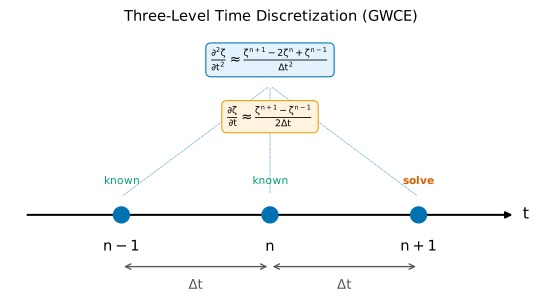
Fig. 19 Three-level time discretization stencil. The second-order temporal derivative uses values at all three levels; the first-order derivative uses the outer two.
The RHS assembly in GwceVectorAssemblyKernels.hpp computes:
where:
Temporal term: \(\frac{A_e}{12\Delta t}\left(\frac{1}{\Delta t} - \frac{\tau_0}{2}\right)(\zeta^n - \zeta^{n-1})\)
Gradient terms: from \(c_{00}\) and \((a_{00}+b_{00})\) coefficients
Momentum term: \(\nabla \cdot \mathbf{J}\)
Wet/Dry Integration
The GWCE assembly iterates over a pre-built wet_element_indices list rather
than checking wet/dry status inline. This index list is built by
wetdry_build_index_lists() after each wet/dry computation, and contains only
elements that are Active with all 3 nodes Wet.
Dry nodes have their matrix row set to EP * delta_zeta = 0, preserving
elevation unchanged.
Boundary Conditions
Dirichlet (Elevation-Specified):
For open boundary nodes with prescribed elevation \(\zeta_{bc}\):
Zero the matrix row except diagonal (set to EP)
Save off-diagonal coefficients for RHS modification
Set RHS to
EP * (zeta_bc - zeta_current)
The elevation penalty (EP) is computed as the RMS of diagonal entries to maintain numerical conditioning.
Flow Boundaries:
Flow boundary conditions (types 22, 30, 32, 52) and weir boundary conditions (types 3, 13, 23, 4, 24) contribute to the GWCE RHS through a boundary integral term.
For each flow boundary node, a forcing quantity \(Q_{\text{force}}\) is computed. For type 22 (specified flux only):
where \(q_n\) is the normal flux per unit width at the boundary node.
For types 30 and 32 (with Sommerfeld radiation):
where:
\(c = \sqrt{gH}\) is the shallow water wave celerity
\(\Delta\zeta^n = \zeta^n - \zeta^{n-1}\) is the elevation increment from the previous GWCE solve
\(\zeta_E\) is the prescribed elevation at the boundary
\(H = h + \zeta\) is the total water depth
The \(2\Delta\zeta^n\) term provides a second-order extrapolation of the model elevation to time level \(n+1\). The radiation terms (proportional to \(c\)) allow outgoing long waves to pass through the boundary without reflection, following the Sommerfeld radiation condition.
\(Q_{\text{force}}\) is then applied to the GWCE RHS via boundary segment integration. For each segment connecting nodes \(i\) and \(j\):
where \(L_{2/3} = \tfrac{2}{3} L\) is the segment length scaled by 2/3. The 2:1 weighting arises from the linear basis function integration over the boundary segment. Wet/dry masking is applied: contributions are zeroed if either endpoint node is dry.
Weir Overflow (Types 3/13/23, 4/24):
Weir boundaries compute \(q_n\) dynamically from the overflow formula rather than prescribing it from a time series. Once \(q_n^{n+1}\) is determined, the standard QFORCE formula applies:
External Weir (types 3/13/23):
External weirs have nodes on one side only. The overflow is always supercritical (free overflow), using only the source-side elevation:
where \(\eta\) is the water surface elevation at the boundary node, \(R\) is the ramp factor, and \(C_p\) is the supercritical discharge coefficient. The negative sign indicates outward flow (out of the domain).
Internal Weir (types 4/24):
Internal weirs have paired nodes on opposite sides of the crest. The overflow depends on the head difference between both sides and can be subcritical (submerged) or supercritical (free), flowing in either direction.
Given node A with elevation \(\eta_A\) and paired node B with elevation \(\eta_B\), define:
The overflow \(q_n\) is computed according to six regimes:
Case 1 — Both below crest (\(h_A \leq 0\) and \(h_B \leq 0\)):
Case 2 — Equal levels (\(|h_A - h_B| < \delta_{\text{eq}}\)):
Case 3 — Outward subcritical (\(h_A > h_B > h_{A,f}\) and \(h_A > h_{\min}\)):
Case 4 — Outward supercritical (\(h_B \leq h_{A,f}\) and \(h_A > h_{\min}\)):
Case 5 — Inward subcritical (\(h_B > h_A > h_{B,f}\) and \(h_B > h_{\min}\)):
Case 6 — Inward supercritical (\(h_A \leq h_{B,f}\) and \(h_B > h_{\min}\)):
where:
\(R\) is the ramp factor
\(C_s\) is the subcritical discharge coefficient
\(C_p\) is the supercritical discharge coefficient
\(h_{\min} = 0.04\) m is the minimum head threshold; no overflow occurs when the head above the crest is below this value
\(\delta_{\text{eq}} = 0.01\) m is the equal-level tolerance; no overflow occurs when the head difference between sides is smaller than this
Negative \(q_n\) indicates outward flow (A to B); positive indicates inward flow (B to A)
The transition between subcritical and supercritical occurs at a head ratio of 2/3, following standard weir hydraulics. Additionally, flow is blocked if the source side has no wet edges adjacent to the boundary node — for each weir node, the previous and next boundary nodes on the same side are checked for wet status, and if neither is wet the overflow is suppressed.
Lumped vs Consistent Mass Matrix
The solver type determines the solution strategy:
Fig. 20 GWCE solver flow for consistent and lumped variants
Cocoa supports two GWCE solver modes corresponding to ADCIRC’s ILUMP parameter:
Consistent Mass Matrix (ILUMP=0):
Uses the standard finite element mass matrix with off-diagonal coupling:
This produces a sparse symmetric matrix that requires iterative solution (Conjugate Gradient with Jacobi preconditioning).
Lumped Mass Matrix (ILUMP=1):
Diagonalizes the mass matrix by summing each row to the diagonal:
This produces a diagonal matrix allowing direct O(N) solution without iteration. The lumped approach trades some accuracy for significant computational savings.
Solver Type Selection:
The GwceSolverType enum controls which coefficients are used:
enum class GwceSolverType {
  Consistent,  // OnDiag=2, OffDiag=1 (ADCIRC ILUMP=0)
  Lumped       // OnDiag=4, OffDiag=0 (ADCIRC ILUMP=1)
};
Both the LHS (matrix, Equation (7)) and RHS (vector) assembly must use matching coefficients. The RHS temporal term uses:
where \(S_i\) is the nodal scale factor (cos(latitude) for spherical coordinates).
Lumped Solver Performance:
The lumped solver eliminates iterative solve overhead but still requires:
RHS assembly (same complexity as consistent)
Diagonal solve:
solution = RHS / diagonalusing Tpetra built-ins
For optimal performance, boundary coefficient structures are cached at initialization rather than recreated each timestep.
Implementation Files
Consistent Solver:
continuity/consistent/GwceSolverConsistent.hpp: Iterative CG solvercontinuity/consistent/GwceMatrixAssemblerConsistent.hpp: Full sparse matrixcontinuity/consistent/ConjugateGradientSolver.hpp: Belos CG wrapper
Lumped Solver:
continuity/lumped/GwceSolverLumped.hpp: Direct diagonal solvercontinuity/lumped/GwceMatrixAssemblerLumped.hpp: Diagonal-only assemblycontinuity/lumped/GwceSolverLumpedKernels.hpp: Solve and update kernels
Shared:
continuity/GwceVectorAssembler.hpp: RHS assembly (parameterized by solver type)continuity/GwceVectorAssemblyKernels.hpp: RHS assembly kernelscontinuity/OpenBoundaryCoefficients.hpp: BC coefficient storage